A good brief is what separates a first cut that needs a conversation from one that needs a note. Hand the same editor the same footage twice and you’ll get noticeably different work back depending on what turned up alongside it. Writing the brief takes about fifteen minutes.
How to brief a wedding film editor: the short version
Four things make a brief useful. Which films you want and roughly how long each should run. What happened on the day, in order. What the couple asked for. And what your own work looks like when you’re the one cutting it. The rest is detail. Those four decide whether version one lands.
Show, rather than describe, your style
Nothing in a brief does more work than a link to one of your finished films. One watch conveys your pacing, your grade, how you handle titles, what you do with music. Try describing any of that in writing and you’ll do it badly across three paragraphs. Send two references rather than one: a film you’re proud of, plus whichever of yours sits closest in tone to this particular wedding.
Written notes are still worth having, but they land best as corrections to the reference instead of descriptions floating free of one. “Like this, but slower through the ceremony” gives an editor something to act on. “Cinematic and emotional” doesn’t.
Music, decided early
Music dictates the structure of the whole cut, which means a track picked after the assembly is built means building it again. Where the couple has a preference, send the actual tracks. Where they don’t, send a clear direction: tempo, instrumentation, whether it needs to build. Licensing counts here too, because anything the couple intends to post has to be cleared. We go into the reasoning in choosing music for a cinematic wedding film.
The details that save a round
Most revisions can be headed off with a short list:
- Names and spellings for any titles, and which partner is which.
- Moments the couple specifically asked for.
- Anyone or anything to keep out, a guest or a moment that went wrong.
- Where the audio is good, and where it failed.
- Whether the ceremony ran in an unusual order.
- The deliverables and formats you need back.
Nothing on that list is dramatic. Leave any one of them out, though, and it usually costs a full round of back-and-forth.
Sending the footage itself
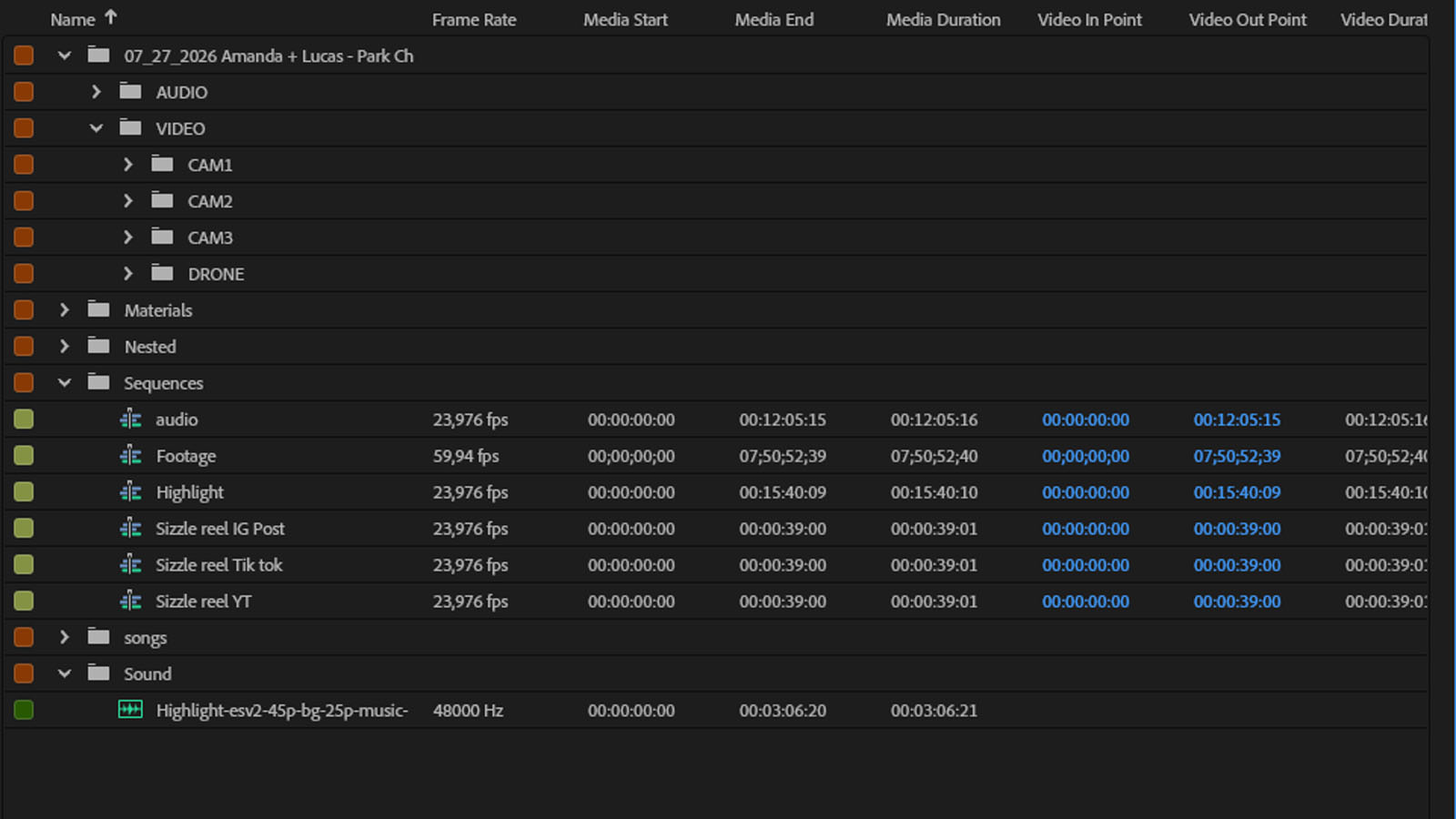
Send it all in one go rather than in stages, and include the angles you’re assuming won’t get used. Reaction coverage makes the film more often than you’d think. Mark separate audio clearly, because a recorder or a house feed is almost always what ends up as the delivered sound rather than camera audio. Keep folders simple instead of clever: camera, audio, drone, stills. And send originals, not transcodes. Proxies can be generated later; quality can’t be recovered.
Being clear about what you are not asking for
Briefs tend to describe the target and skip the boundaries, and the boundaries are where mismatches happen. If you never use speed ramps, say so. If you want the vows left whole rather than trimmed to length, say that too, and we make the case for it in editing wedding vows. If the couple has fixed a length, flag it, because it changes what comes out, which we cover in what to cut from a wedding film.
Briefing gets shorter over time
Your first brief to a new editor is the long one. A few weddings in, the style is understood and the brief shrinks to whatever is specific about this event. That’s the real case for staying with one partner through a season instead of a different freelancer every time. It’s what a wedding post-production partner is for, and how our wedding film editing for studios is set up. Starting from a first project, request a studio quote and send one wedding with a brief along these lines.
Looking for a post-production partner?
We edit cinematic wedding films for filmmakers and studios — graded, paced, delivered in ten days, under your brand.